
The Future of Cryocooling is Landing on Your Benchtop
Stop leaving your diffraction data to chance. Experience the next evolution in automated crystal cryocooling. Perfectly reproducible and with minimal cryoprotectants needed—now in a compact, desktop footprint. Available for pre-orders now! Units begin shipping late February 2027.
Unparalleled Diffraction Data, Every Time
Don't Let Manual Cooling Compromise Your Research and Development Pipeline
Poor cryocooling results in lower diffraction quality, leading to missed hits and thousands of dollars in wasted lab time and beamtime. Our upcoming system transforms cryocooling from a manual risk into a standardized advantage.
- Maximize Your Beamtime: Increase your ROI at the synchrotron by arriving with contamination-free, low cryoprotectant samples
- Eliminate Chance: Move away from the variability of manual plunging. Our proprietary automation and cold gas removal technology ensure that every sample is cooled identically and ultra-rapidly, regardless of operator, producing consistently high-resolution diffraction data with minimal background noise.
- High-Throughput Reliability: Automated sample placement directly into the puck eliminates samples lost from inadvertent pin collisions.
- Capture Every Lead: Ensure you are getting the best possible diffraction from every crystal. Don't let a "missed hit" be the result of a poor manual plunge.
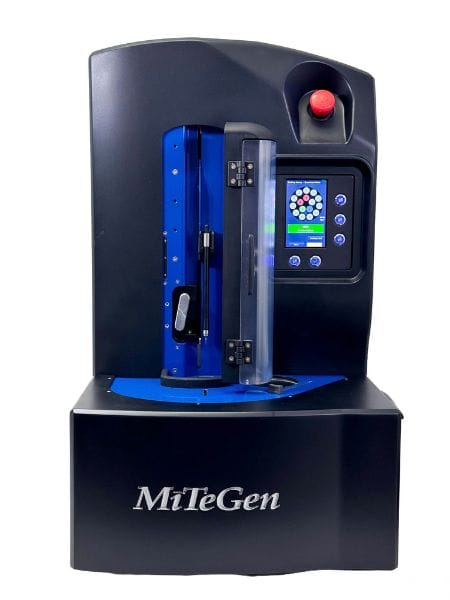
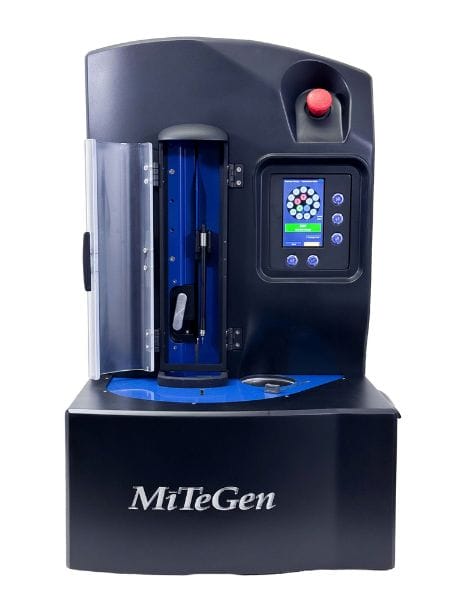
NANUQ™ Desktop HT Abstract
Abstract: Automation of High-Velocity Cryocooling for Enhanced Reproducibility in Macromolecular Crystallography
Background: Cryocooling remains a critical yet highly variable step in the macromolecular crystallography workflow. By virtue of its operator dependence and inherent imprecision, manual plunge-cooling techniques often introduce inconsistencies in cooling rates and exposure to temperature gradients, which can lead to crystalline ice formation, increased mosaicity, and degraded diffraction quality. Moreover, standard manual plunge-cooling setups fail to prevent the accumulation of crystalline water "ice contamination" throughout the dewar in which samples are being cooled and stored. These contaminants often adhere to and cover the sample, meaning that even well vitrified samples may be difficult or impossible to use. This is especially true for automated workflows that require clear views of fiducials in order to function properly. These variables frequently result in lost primary data and inefficient use of high-demand synchrotron beamtime.
Approach: We are developing a novel, automated desktop cryocooling system designed to eliminate the stochastic nature of manual sample preparation. The system utilizes a precision-engineered drive mechanism to achieve a constant plunge velocity of 2.0 m/s, coupled with patented cold gas removal technology. This ensures a near-instantaneous thermal transition from ambient (+20°C) to cryogenic (-197°C) temperatures, bypassing the detrimental pre-cooling effects of the cold gas layer above the liquid nitrogen (LN2) surface. The system is designed to ensure that, throughout operation, exposure of the LN2 used to cool and store samples to humid, ambient air is minimized. This, coupled with the large hold capacity of the system's internal dewar, ensures that ice contamination is maintained below levels harmful to samples. The device integrates an auto-leveling LN2 reservoir to maintain a constant immersion depth, ensuring uniform thermal quenching across high-throughput sample batches. Full-cycle automation manages the sample trajectory from the initial plunge through to puck placement and retrieval. By standardizing these physical parameters, the system achieves a level of amorphous ice consistency that is mechanically unattainable using manual intervention.
Impact: This automated approach provides a robust framework for improving data reproducibility in both high-throughput pharmaceutical pipelines and academic research. By mitigating the "human element" in sample preparation, the system minimizes sample loss and ensures that diffraction quality is limited only by the intrinsic properties of the crystal, rather than the cooling methodology. Moreover, by producing contaminant-free samples of an identically high quality, this instrument is ideally suited for integration into existing, semi-automated crystallography pipelines, especially those that rely on machine vision.
Published Literature Using High Speed Plunge Cooling with Cold Gas Removal
[1] M. Warkentin, V. Berejnov, N. S. Husseini, and R. E. Thorne, “Hyperquenching for protein cryocrystallography,” J Appl Crystallogr, vol. 39, no. 6, pp. 805–811, Nov. 2006, doi: 10.1107/s0021889806037484.
[2] M. Warkentin and R. E. Thorne, “A general method for hyperquenching protein crystals,” J Struct Funct Genomics, vol. 8, no. 4, pp. 141–144, Oct. 2007, doi: 10.1007/s10969-007-9029-0.
[3] J. A. Clinger, D. W. Moreau, M. J. McLeod, T. Holyoak, and R. E. Thorne, “Millisecond mix-and-quench crystallography (MMQX) enables time-resolved studies of PEPCK with remote data collection,” IUCrJ, vol. 8, no. 5, pp. 784–792, Aug. 2021, doi: 10.1107/s2052252521007053.[4] M. Schuller et al., “Fragment binding to the Nsp3 macrodomain of SARS-CoV-2 identified through crystallographic screening and computational docking,” Sci. Adv., vol. 7, no. 16, Apr. 2021, doi: 10.1126/sciadv.abf8711.
[5] G. Illava et al., “Integrated sample-handling and mounting system for fixed-target serial synchrotron crystallography,” Acta Crystallogr D Struct Biol, vol. 77, no. 5, pp. 628–644, Apr. 2021, doi: 10.1107/s2059798321001868.[6] J. A. Indergaard et al., “Instrumentation and methods for efficient time-resolved X-ray crystallography of biomolecular systems with sub-10 ms time resolution,” IUCrJ, vol. 12, no. 3, pp. 372–383, Apr. 2025, doi: 10.1107/s205225252500288x.
[7] T. Engstrom et al., “High-resolution single-particle cryo-EM of samples vitrified in boiling nitrogen,” IUCrJ, vol. 8, no. 6, pp. 867–877, Sep. 2021, doi: 10.1107/s2052252521008095. [8] A. Abdelhady et al., “Ice-free vitrification of embryos and its impact on post-warming outcomes,” Sci Rep, vol. 16, no. 1, May 2026, doi: 10.1038/s41598-026-46755-9.[9] J. B. Hopkins, R. Badeau, M. Warkentin, and R. E. Thorne, “Effect of common cryoprotectants on critical warming rates and ice formation in aqueous solutions,” Cryobiology, vol. 65, no. 3, pp. 169–178, Dec. 2012, doi: 10.1016/j.cryobiol.2012.05.010.