
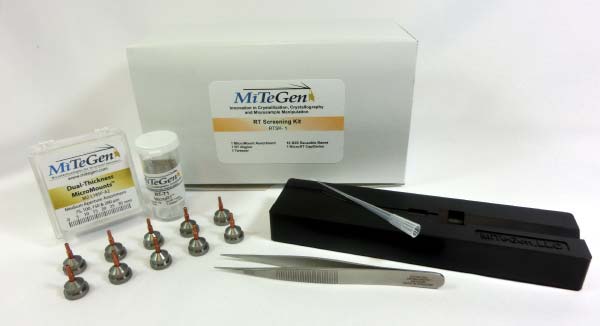
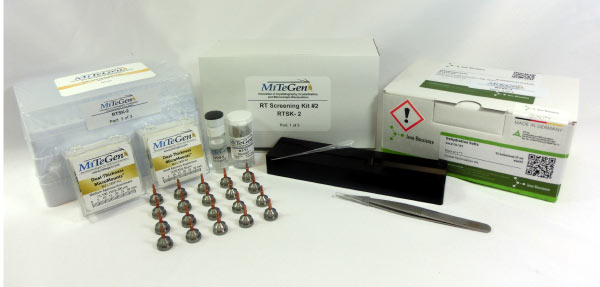
MicroRT Room Temperature Starter Kits
Get started preparing samples for room temperature screening.
Product Information
MiTeGen’s patented MicroRT™ capillary system is the answer for room temperature diffraction screening and data collection. Go from a crystal in a drop to a crystal in the X-ray beam at room temperature quickly and easily. Collect room and low temperature data from the same crystal to evaluate your crystal and cryopreservation protocol. And use saturated salt solutions to controllably dehydrate crystals and improve their order.
Why collect diffraction data at room temperature?
Room temperature screening is especially important in protein crystallography. Roughly 98% of low-temperature data sets collected on structural biology beam lines do not yield diffraction data of sufficient quality to determine a structure. Room temperature measurements are essential to determine whether the cause of poor diffraction is poor as-grown crystal quality, sample damage caused by ligand and/or cryoprotectant soaks, and/or sample damage caused by the flash cooling process itself. Far too much effort is wasted searching for cryoprotection conditions for crystals that are poorly ordered to start with. Far too much synchrotron beam time is wasted on crystals that should have been rejected in home source screening.
The MicroRT system provides an extremely cost effective tool for increasing the efficiency of your diffraction pipeline.
Design
In the MicroRT system, a sample is mounted on, e.g., a MicroMount or MicroGripper that is inserted into a goniometer base, just as for cryocrystallography. A MicroRT capillary is then drawn over the sample and onto the base.

Standard 10 μm wall glass X-ray capillaries are replaced with 25 μm wall transparent polymer capillaries that are presealed at one end. Although the polymer is thicker, it’s C and H scatter X-rays much more weakly than glass’s Si and O, so overall background scatter is reduced by 60%. The capillary diameter, 2 mm, is much larger than your crystal and MicroMount, and mates with our modified goniometer bases that both hold the MicroMount and capture the tubing.
Unlike with conventional X-ray capillary mounting, the MicroRT capillary simply provides a protective cover, and the sample makes no contact with it.
To prepare a sample for room temperature measurements:
- Using a gel-loading pipette tip, inject humidity-stabilizing liquid (e.g., mother liquor or well solution) down into the capillary toward its sealed end.
- Insert your MicroMount / MicroGripper / MicroLoop / MicroMesh into a goniometer base, and then mount your sample as you would for cryocrystallography.
- Draw the capillary tubing down over the sample and mount and onto the narrowed neck of the goniometer base.
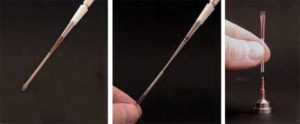

Unlike in conventional capillary mounting, the sample is held away from the capillary wall and so there is no liquid/wall optical distortion. Sample imaging is excellent, and the sample can be aligned in the X-ray beam using standard autoalignment software.
Once you've collected your room temperature frames, just pop off the tubing, plunge the MicroMount in your liquid cryogen, and you're ready to collect a low-temperature data set. Or else soak your crystal in the next solution, pop the plastic tubing back on, and repeat until you've checked out each solution.
The MicroRT system also provides an easy way to controllably dehydrate your samples, which can yield significant improvements in diffraction quality. See our technical notes for details.
Features
- Allows rapid screening of crystals at room temperature, to help maximize the efficiency of your crystallography pipeline.
- Easy sample mounting with little risk of crystal loss or damage.
- Easy collection of both room and low-temperature data from the same sample.
- Easy sample visualization and alignment, especially for small crystals.
- Capillary tubing is easily cut and sealed , and gives significantly less background X-ray scatter than glass capillaries.
- One size capillary fits all , and capillaries are reusable, lowering your cost per measurement.
You may also like…
-
Crystallophore Pre-Screening Agents
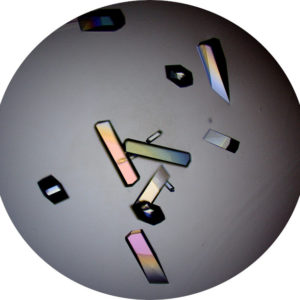 You have your choice of two Crystallophore Pre-Screening Agents. Both are mainly adapted to soluble proteins...
 -
Watershed – Optimized Crystal Harvesting
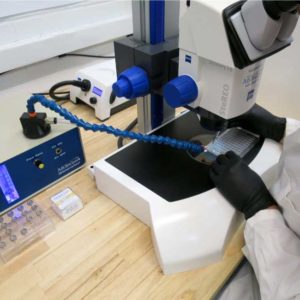 Prevent loss or damage to the crystals that you’ve spent time growing and optimizing. The Watershed™...
 -
Protein Crystallography Starter Kit
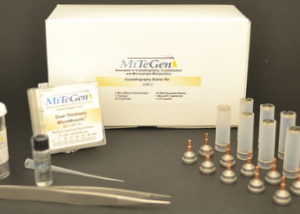 MiTeGen’s Protein Crystallography Starter Kit has everything you need to mount and collect X-ray data...